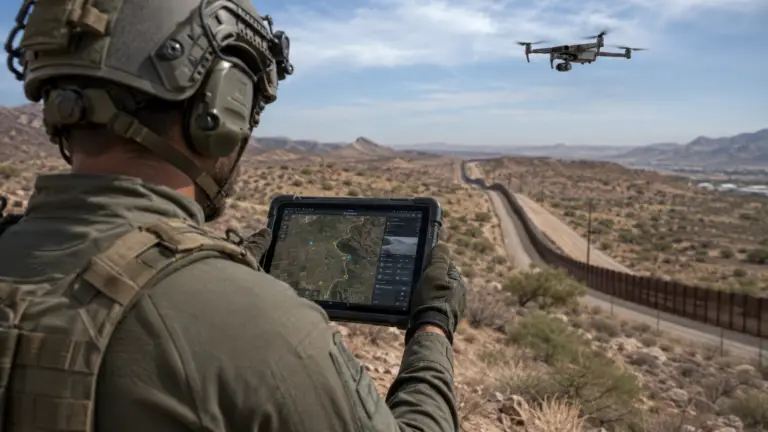
An encrypted FPV video link is no longer a technical luxury — it is a mission-critical requirement for any military drone operation. As adversaries become more sophisticated in electronic warfare, unprotected video feeds are vulnerable to interception, spoofing, and jamming. Security force commanders and defense procurement officers must understand the technologies that protect drone feeds — and the consequences of deploying systems that do not meet operational security standards.
This article examines why encryption is essential for military FPV drone communications, how analog and digital systems compare, the threat landscape, and the key technologies now available — including ELRS, O4 systems, and AES-256 encryption. ARMA GIDEON supplies defense-grade solutions designed for the most demanding operational environments.
Why Encryption Matters for Military Drone Feeds
The Value of the Video Feed
A drone’s First Person View (FPV) video feed is one of the most operationally sensitive data streams in a modern military mission. It reveals troop positions, target identification, route planning, and real-time intelligence that adversaries would exploit with devastating effect if intercepted.
Unencrypted video links transmit in the clear — meaning any actor with off-the-shelf signal intelligence equipment can receive, decode, and act on that information. In high-density electronic warfare environments, this is not a theoretical risk. It is an observed operational failure documented in multiple active conflict theaters over the past decade.
What Interception Looks Like in Practice
Electronic warfare units routinely monitor radio frequency spectrums in conflict zones. Analog FPV systems — which transmit on fixed frequencies with no signal encryption — are particularly vulnerable. An adversary can:
- Passively receive and decode the video stream without the drone operator’s knowledge
- Identify operator positions by triangulating the ground control station (GCS) transmitter signal
- Use the intercepted feed to predict and counter drone movements
- Inject false signals to confuse or hijack navigation
These are not edge cases. They are documented capabilities observed in active theaters and discussed openly in publications including Breaking Defense and Jane’s Defence Weekly.
Analog vs. Digital Encrypted Systems
Analog FPV Systems: Legacy Limitations
Analog transmission technology was the foundation of FPV drone systems for over a decade. It offers low latency and simplicity, but it provides no signal encryption whatsoever. Analog video is broadcast openly on a single frequency, making it trivially easy to intercept.
For training scenarios with no adversarial threat, analog has a role. For military operations — particularly BVLOS (Beyond Visual Line of Sight) missions — analog systems represent an unacceptable security risk.
Key weaknesses of analog systems in military contexts:
- No signal encryption or authentication
- Fixed frequency transmission — easily located and jammed
- No frequency hopping or spread spectrum capability
- Low image resolution limits intelligence value
Digital Encrypted Systems: The Operational Standard
Modern digital FPV systems use packet-based transmission with encryption layers, frequency agility, and error correction. Defense-grade systems layer AES-256 encryption over the video and telemetry data stream, ensuring that intercepted signals are computationally infeasible to decode in operationally relevant timeframes.
Digital systems also support:
- Dynamic frequency hopping to resist jamming
- Bidirectional encrypted communication between drone and GCS
- High-definition video with latency under 30ms in optimized configurations
- Integration with ground control station (GCS) software for mission management
The shift from analog to digital encrypted transmission is not merely a performance upgrade. It is a security transformation that defines whether a drone platform is operationally viable.
For organizations evaluating tactical drone platforms, our tactical drone solutions provide an overview of the complete system architecture.
The Jamming and Electronic Warfare Threat
Jamming: Disruption by Design
Jamming is the deliberate transmission of radio frequency energy to disrupt communications between a drone and its GCS. In military operations, adversaries deploy portable, vehicle-mounted, or fixed jamming systems across commonly used FPV frequency bands — typically 2.4 GHz and 5.8 GHz.
A jammed drone with no fallback protocol will either hover in place, return to its launch point, or crash — all of which may be operationally unacceptable. A drone operating on a frequency-hopping encrypted link is significantly harder to jam effectively, because the transmitter and receiver constantly move across the spectrum in a synchronized, unpredictable pattern known as jamming resistance by design.
Electronic Warfare: The Broader Threat Landscape
Electronic warfare (EW) against drone systems encompasses:
- Signal jamming: Blocking the control link or video downlink
- GPS spoofing: Feeding false position data to navigation systems
- Protocol exploitation: Attacking weaknesses in unencrypted or poorly secured communication protocols
- Direction finding: Locating and targeting the GCS using its radio emissions
Defense procurement professionals evaluating FPV drone systems must assess each of these threat vectors. A system that cannot maintain encrypted communication under active jamming is not operationally viable in a contested environment.
According to NATO communications security standards, all tactical data links carrying intelligence-relevant information must employ approved cryptographic protocols. This extends explicitly to unmanned aerial system (UAS) video feeds operating in theater. See the NATO Communications and Information Agency for the applicable framework.
Key Technologies Securing Military FPV Links
ELRS — ExpressLRS for Tactical Applications
ELRS (ExpressLRS) is a packet-based radio control and telemetry protocol with a specification optimized for range, reliability, and adaptability. In its defense-adapted form, ELRS provides:
- Extremely low-latency bidirectional communication
- High jamming resistance through frequency hopping spread spectrum (FHSS)
- Long-range operation with high-gain antennas at ranges exceeding 30 km in line-of-sight configurations
- Compatibility with encrypted payload overlay protocols
ELRS is increasingly adopted as the control-link backbone for tactical drone platforms because it delivers the range and reliability required for BVLOS operations while remaining adaptable to military-grade security overlays.
O4 System: Defense-Grade Digital Video
The O4 digital video transmission system represents a significant advance in low-latency encrypted video for tactical drones. Key features relevant to military procurement:
- AES-256 signal encryption on video and control channels
- Adaptive bitrate with sub-30ms latency under nominal conditions
- Frequency agility and anti-interference design
- Dual-band operation for flexibility in contested RF environments
- Integration with professional-grade GCS platforms
O4-class systems are designed for operation in environments with active interference, making them a preferred choice for frontline tactical drone deployments where signal encryption is non-negotiable.
AES-256: The Encryption Standard
AES-256 (Advanced Encryption Standard, 256-bit key) is the cryptographic algorithm used by NATO nations and allied security forces for classified data protection. In the context of drone video links, AES-256 encryption means:
- Each video packet is encrypted before transmission
- Decryption requires the matching key, held only by authorized GCS units
- Brute-force decryption of AES-256 is computationally infeasible with current technology
- Key management protocols control how encryption keys are distributed and rotated
For defense procurement, requiring AES-256 on drone video links is the baseline standard. Systems not meeting this specification should not be considered for operational deployment.
High-Gain Antennas for Range and Reliability
High-gain antennas increase the effective range of FPV video links and improve signal quality in challenging environments. In military deployments, high-gain directional antennas on the GCS allow:
- Extended BVLOS range without sacrificing link quality
- Improved resistance to multipath interference in urban environments
- Reduced power requirements at the drone — extending flight time
- Antenna tracking systems that maintain orientation toward the drone automatically
Pairing high-gain antennas with an encrypted digital video link creates a resilient, long-range communication architecture suitable for serious operational requirements.
GCS Integration and Operational Security
Ground Control Station Requirements
The ground control station (GCS) is the hub of all drone communications. A secure GCS must:
- Decrypt incoming video streams in real time without added latency
- Manage encryption keys securely with hardware or software key storage
- Support multiple drone feeds simultaneously in complex operations
- Provide operators with signal quality metrics to detect active jamming attempts
- Log all communications for post-mission analysis and accountability
GCS software that lacks integration with encrypted video links creates a security gap even when the drone itself is properly secured. The entire communication chain — from drone to GCS — must be treated as a single encrypted system.
BVLOS Operations and Extended Security Requirements
BVLOS operations — where the drone flies beyond the visual line of sight of the operator — place the greatest demand on secure encrypted links. At BVLOS ranges:
- The operator relies entirely on the video feed for situational awareness
- Any interruption to the encrypted link may require autonomous failsafe behavior
- The risk of interception increases as the signal travels greater distances
- High-gain antennas and frequency-hopping protocols become essential, not optional
For military and security force planners, BVLOS capability without robust signal encryption is not a capability — it is a liability.
ARMA GIDEON Solutions for Encrypted Drone Communications
ARMA GIDEON provides defense-grade tactical drone systems with fully integrated encrypted FPV video links, designed for security forces, special operations units, and border security applications. Our platforms are configured for operational deployment — not evaluation laboratories.
Key capabilities ARMA GIDEON delivers:
- AES-256 encrypted video and telemetry on all tactical drone platforms
- O4 and ELRS-based communication systems with frequency hopping for jamming resistance
- High-gain antenna systems for extended BVLOS operational ranges
- Integrated GCS platforms with real-time encrypted video display and key management
- Electronic warfare resilience tested against active jamming environments
- Full counter-UAV awareness — understanding both how drones are secured and how threat drones are neutralized
ARMA GIDEON works directly with defense procurement offices to configure systems meeting specific mission requirements, theater conditions, and national certification standards.
For organizations evaluating counter-UAV integration alongside offensive drone capabilities, our counter-UAV systems provide a complete picture of the drone threat landscape. Our cyber defense advisory services extend encrypted communications best practices beyond the airspace to ground-based networks and command infrastructure.
Conclusion
The encrypted FPV video link is the foundation of any operationally credible military drone program. Unencrypted analog systems expose missions, operators, and assets to adversary threats that are well-documented, technically accessible, and growing in sophistication. Digital systems with AES-256 encryption, ELRS protocols, O4 video transmission, and high-gain antennas deliver the security and reliability that modern operations demand.
Electronic warfare threats are not future concerns — they are present realities in every contested operational environment. Defense procurement decisions made today determine whether drone platforms are mission assets or mission liabilities.
ARMA GIDEON is ready to support your evaluation, procurement, and deployment planning. Contact our defense solutions team to discuss your specific operational requirements and mission profile.
Contact ARMA GIDEON — Secure your drone communications today.