Perimeter Security Systems for Military Bases and Critical Infrastructure
Perimeter security systems are the first line of defense for military installations, government facilities, and critical infrastructure. An effective perimeter security architecture doesn’t simply detect threats — it delays, channels, and ultimately defeats them before they reach protected assets. This guide is for base commanders, facility security officers, and infrastructure protection professionals who need to design or upgrade perimeter defenses that work in real operational conditions.
The Layered Defense Principle
Effective perimeter security is never a single barrier or a single sensor. It is a series of concentric, mutually supporting layers — each designed to detect, slow, and report threats while providing time for a security response. The standard framework operates on three layers:
Outer Zone: Detection and Warning
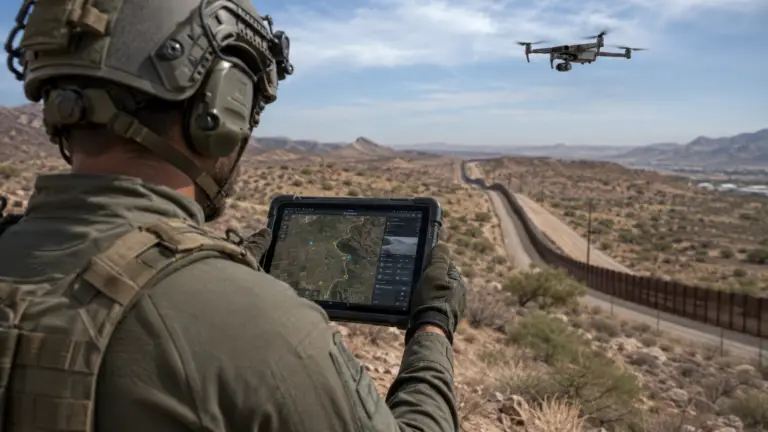
The outer zone extends beyond the physical perimeter fence. Its purpose is early warning — detecting threat presence before it reaches the barrier. Technologies deployed in the outer zone include:
- Ground-based radar — detects personnel and vehicle movement at ranges of 500m–5km
- Unattended ground sensors (UGS) — seismic, magnetic, and acoustic sensors deployed in approaches
- Thermal surveillance cameras — continuous 24/7 imaging of the approach zone
- Counter-UAV sensors — drone detection radar and RF direction finders
Barrier Zone: Physical Delay
The physical perimeter is designed to delay, channel, and frustrate penetration. Modern perimeter barrier systems integrate:
- Anti-vehicle barriers — hostile vehicle mitigation (HVM) bollards, crash-rated gates, cable barriers
- Security fencing — high-security mesh, anti-climb profiles, buried groundwork
- Intrusion detection systems (IDS) — fiber-optic, vibration, or electric field sensors integrated into the fence line
- Lighting systems — motion-activated, graduated-intensity lighting that degrades attacker night vision while supporting defender visibility
Inner Zone: Response and Intervention
The inner zone enables the security force to respond to a confirmed threat. This layer includes guard posts, quick reaction force (QRF) staging, and the command-and-control infrastructure that coordinates the response — including the ability to direct drone assets, canine units, and vehicle patrols.
Sensor Integration and the Common Operating Picture
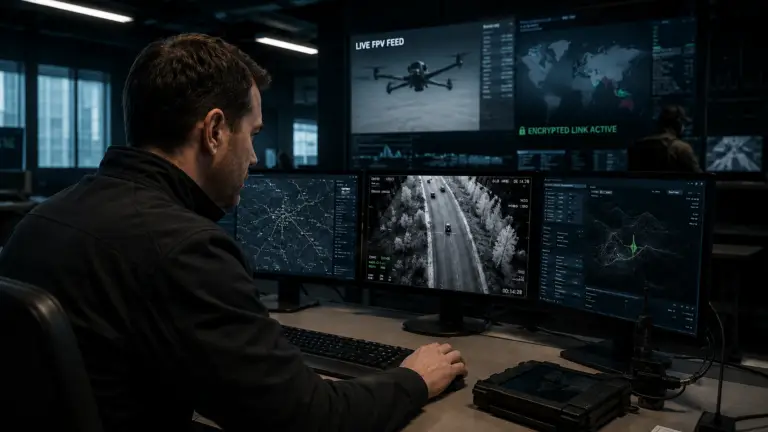
Modern perimeter security is defined not by individual sensors but by sensor fusion — the integration of multiple data streams into a single, actionable common operating picture (COP). A well-designed system aggregates feeds from radar, cameras, UGS, and drone sensors into a unified command interface that allows a single operator to monitor an entire perimeter and direct the response force with precision.
ARMA GIDEON designs perimeter security architectures that integrate:
- Thermal and visible-light camera arrays with AI-based motion analytics
- Ground radar with automatic cueing to cameras
- Fence-line intrusion detection with GPS-precise alarm location
- Counter-UAV detection linked to neutralization systems
- Unified command software with map-based display and alarm management
Counter-UAV Integration in Perimeter Defense
The rise of commercial and weaponized drones has fundamentally changed the perimeter security calculus. A threat that can approach from any angle, at any altitude, with no ground signature requires a dedicated counter-UAV layer integrated into the broader perimeter system.
Effective counter-UAV perimeter integration includes:
- Detection: 360° radar coverage supplemented by RF signal detection
- Classification: AI-assisted differentiation between commercial, military, and friendly drones
- Response: Tiered response options from jamming to kinetic neutralization, authorized by command
- Logging: Automatic recording of all drone events for intelligence and legal purposes
ARMA GIDEON’s counter-UAV capability is detailed in our dedicated Counter-UAV Systems guide.
Critical Infrastructure: Unique Requirements
Power stations, water treatment facilities, communications nodes, and fuel storage sites present distinct perimeter security challenges compared to military bases:
- Continuous civilian interface — authorized personnel and vehicles must flow freely while threats are denied
- Detection sensitivity — false alarms at a power station have operational consequences; the system must be reliable, not just sensitive
- Regulatory compliance — critical infrastructure protection often operates under legal frameworks that mandate specific security standards
- Legacy infrastructure integration — new security systems must interface with existing access control, CCTV, and alarm infrastructure
ARMA GIDEON designs critical infrastructure perimeter systems with these constraints explicitly addressed — ensuring that security enhancement does not degrade operational function.
Human Factors: The Security Force Component
Technology cannot replace trained security personnel — it enhances them. The most advanced sensor array is only as effective as the response it enables. Perimeter security design must account for:
- Guard force sizing — determined by response time requirements, not intuition
- Fatigue management — automated systems reduce cognitive load on guards, improving detection reliability
- Training programs — operators must be trained on the specific COP software and response protocols
- Standard operating procedures (SOPs) — clear escalation protocols for each threat category
Procurement and Implementation Approach
Perimeter security projects require a structured implementation process:
- Site survey and threat assessment — identify specific threat vectors, assess existing infrastructure, map terrain
- Concept design — produce a layered security concept with technology and personnel components
- Detailed specification — produce equipment specifications and installation drawings
- Procurement and installation — manage supply chain, installation contractors, and integration testing
- Training and handover — train security personnel on the complete system
- Ongoing maintenance — preventive maintenance schedule and response SLA
ARMA GIDEON provides full turnkey capability across all six stages, or can support specific stages where a client has existing capability.
Protecting What Matters
A perimeter breach at a military installation or critical infrastructure site is not just a security failure — it can be a national security event. The investment in layered, integrated perimeter security is not overhead. It is force protection, operational continuity, and in many cases, strategic deterrence.
For commanders and facility security officers evaluating or upgrading their perimeter defenses, the starting point is always a clear-eyed assessment of the actual threat environment — not a generic specification applied from a standard template.
Request a Site Assessment
ARMA GIDEON provides confidential site assessments and perimeter security design services for qualified military, government, and critical infrastructure clients. Our team brings operational experience and proven technology integration to every project.
Contact ARMA GIDEON to arrange a site assessment and security design consultation.