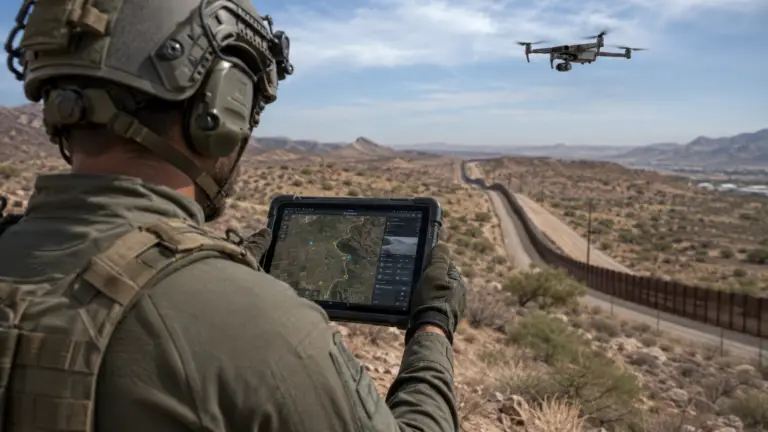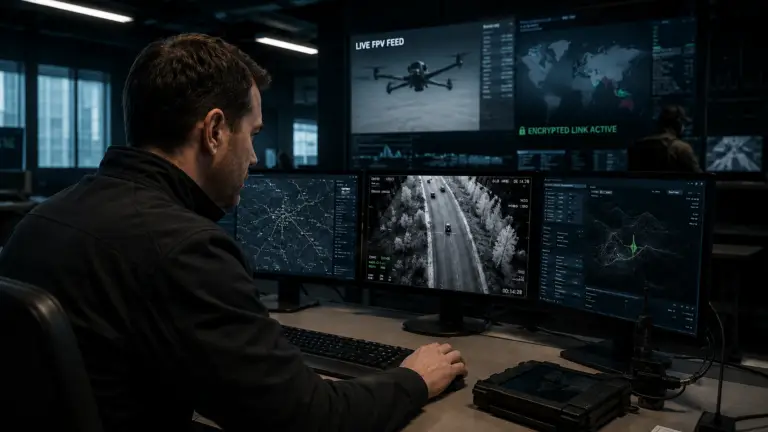
Counter-UAV systems have moved from specialized military capability to essential security infrastructure. Drones are now weaponized by state and non-state actors, smuggled over prison walls, flown over airports, and used to conduct surveillance on critical facilities. For security commanders, government authorities, and airport security managers, the question is no longer whether to invest in counter-UAV systems — it is which architecture to deploy and how to procure it correctly.
This guide provides a structured, procurement-focused breakdown of detection technologies, neutralization methods, drone threat categories, and the criteria that matter most when evaluating a C-UAS solution.
The Growing Drone Threat Landscape
The global counter-UAV market was valued at nearly $5 billion in 2025 and is projected to exceed $36 billion by 2035. That growth is driven by a fundamental shift in how drones are used — and misused.
Commercially available drones now carry payloads exceeding 2 kg, fly beyond visual line of sight (BVLOS), and operate autonomously without a live operator. Threat actors have adapted quickly.
Military and Terrorist Applications
In active conflict zones — including those directly relevant to Israel’s security environment — adversaries use UAVs for real-time ISR, precision munitions delivery, and kamikaze strikes against armored assets and personnel. Iranian-backed groups have deployed drone swarms designed to overwhelm air defense systems through sheer volume and coordinated attack patterns.
Commercial Drones Repurposed as Weapons
Commercially available quadcopters — widely available, inexpensive, and easily modified — are used to drop improvised explosive devices over prison yards, carry contraband across borders, and conduct unauthorized reconnaissance over defense facilities. The barrier to entry for a drone-based attack has never been lower.
Drone Threat Categories — What You Are Up Against
Effective counter-UAV systems are designed around a structured threat taxonomy. Understanding the categories determines the sensor mix and the neutralization strategy.
Low, Slow, and Small (LSS) UAVs
This is the most common and most difficult threat category to address. LSS drones — typically Group 1 UAVs under 20 kg — fly at low altitudes, generate small radar cross-sections, and can approach facilities at low speed without triggering traditional air defense systems. Consumer quadcopters used for smuggling and IED delivery fall in this category.
BVLOS and Autonomous Drones
Beyond visual line of sight drones operate without a continuous RF link to a human operator. Pre-programmed autonomous flight paths make them resistant to standard RF detection and jamming — the drone simply continues its mission. This category includes fixed-wing loitering munitions and Group 2 platforms with onboard AI-guided navigation.
Coordinated Swarm Attacks
Multiple drones operating in a coordinated pattern represent the highest-end threat. NATO doctrine identifies swarm tactics as a primary challenge for existing air defense architectures. A swarm can saturate sensor coverage, divide defender attention, and overwhelm systems designed to engage single targets. Effective counter-UAV systems for high-value facilities must be designed with swarm scenarios as a baseline planning assumption, not an edge case.
Detection Methods — Sensing the Threat
No single sensor modality detects all drone types in all environments. Robust counter-UAV systems integrate multiple detection layers to achieve reliable identification across threat categories.
Radio Frequency (RF) Detection
RF detection systems analyze the radio spectrum for communication signals between a drone and its operator. Most commercial drones transmit on known frequency bands (2.4 GHz, 5.8 GHz). RF sensors can detect the drone, identify its model in some cases, and geolocate both the drone and its operator.
Limitation: Autonomous drones that do not rely on active RF links — such as pre-programmed fixed-wing platforms — produce no detectable RF signature and bypass this layer entirely.
Radar Systems
Radar is the most reliable sensor for detecting moving objects regardless of their RF activity. Modern C-UAS radars are optimized for detecting low-altitude, slow-moving, small targets — the LSS threat profile — distinguishing drone returns from ground clutter, birds, and other environmental noise. Multi-mode radar systems can simultaneously track multiple targets and provide fire-control quality data for kinetic or directed-energy engagement systems.
Electro-Optical and Infrared (EO/IR) Sensors
EO/IR cameras provide visual confirmation of detected targets. Daytime electro-optical cameras identify drone type, payload, and flight behavior. Thermal infrared sensors extend detection to nighttime operations. EO/IR is typically cued by radar or RF detection rather than used as a primary search sensor, but it provides the operator with positive identification before any neutralization decision is made.
Acoustic Detection
Acoustic sensors detect the distinctive rotor and motor noise signatures of multirotor drones. They are effective in close-range, low-noise environments — prisons, forward operating bases, VIP protection perimeters — but are limited by ambient noise and environmental conditions. Acoustic sensors are best used as a redundant layer in an integrated system rather than a standalone capability.
Neutralization Methods — Stopping the Threat
Detection without the ability to act is insufficient. Counter-UAV systems must pair detection with appropriate neutralization options matched to the operational environment and legal authority of the operator.
Electronic Countermeasures — RF Jamming and GPS Spoofing
RF jamming is the most widely deployed soft-kill countermeasure. By flooding the drone’s control frequencies with interference, jamming severs the link between operator and aircraft. Most commercial drones respond by hovering in place, returning to their launch point, or landing — creating an opportunity for forensic recovery and operator location.
GPS spoofing feeds false positioning data to the drone’s navigation system, redirecting it to a controlled landing area. This is particularly effective against autonomous drones that depend on GPS rather than operator control.
Important: In many jurisdictions, including within the United States, authorization to operate RF jamming equipment is restricted to federal agencies. Security commanders procuring C-UAS systems must confirm their legal authority to employ electronic countermeasures before acquisition.
Kinetic Interception
Kinetic methods physically destroy or disable the target drone. Options include:
- Interceptor drones — autonomous or remotely piloted aircraft that ram or net-capture the threat drone
- Net launchers — ground-based or airborne systems that deploy capture nets to entangle rotor blades
- Directed projectiles — from shotgun-style drone-defeat munitions to precision-guided effectors for Group 2+ targets
Kinetic solutions are effective against hardened or autonomous drones that electronic countermeasures cannot stop. However, they introduce risks of falling debris and are generally unsuitable for use near active flight paths or populated areas. For airport environments, non-kinetic methods are the regulatory standard.
High-Energy Lasers and Directed Energy
Directed energy systems use a focused laser beam to destroy a drone’s structure or electronics. High-energy laser systems offer significant tactical advantages: near-zero cost per engagement, unlimited magazine depth, and the ability to engage targets that are hardened against jamming or operating without an RF link.
Modern vehicle-mounted and fixed-installation laser systems documented in open-source defense literature are capable of engaging drone-size targets at extended ranges with high precision. As unit costs decrease and power generation technology improves, directed energy is becoming a viable component of layered C-UAS architectures for permanent installations.
Cyber Takeover
Protocol exploitation allows an operator with sufficient technical capability to take control of a target drone mid-flight, land it in a controlled area, and recover the platform and its payload intact. This method requires detailed knowledge of the target drone’s communications protocol and is generally limited to specialized military units and advanced government programs. For ARMA GIDEON’s capabilities in the broader electronic domain, see our cyber and electronic defense consulting services.
Building a Multi-Layer Defense Architecture
The key principle of effective counter-UAV system design is layered defense. No single technology addresses the full threat spectrum. The U.S. Department of Homeland Security’s C-UAS framework emphasizes integration of detection sensors, automated tracking, and multiple mitigation options within a unified command-and-control architecture.
A sound layered architecture includes:
- Long-range radar for wide-area detection and early warning
- RF sensors for detection and operator geolocation of commercially controlled drones
- EO/IR cameras for visual confirmation and target identification
- Acoustic sensors as a close-range redundant layer
- Electronic countermeasures as the primary soft-kill option
- Kinetic or directed-energy effectors as hard-kill backup for threats electronic countermeasures cannot defeat
- Unified C2 software integrating all sensor feeds, automating detection-to-alert, and supporting human-in-the-loop engagement decisions
The system should be scalable — appropriate for a single fixed installation or a deployable architecture covering multiple sites. Integration with existing perimeter security, border surveillance systems, and command-and-control networks significantly amplifies operational effectiveness. ARMA GIDEON’s border surveillance solutions are designed with this integration requirement in mind.
Procurement Criteria for Counter-UAV Systems
Security commanders evaluating counter-UAV systems should assess the following criteria before committing to a platform or vendor.
| Criterion | What to Evaluate |
|---|---|
| Threat Scope | Define which threat categories (LSS, BVLOS, swarm) the system must address; this determines sensor mix and neutralization options |
| Detection Range & Accuracy | Declare realistic detection ranges per modality; assess false alarm rates under operational conditions |
| Integration Compatibility | Confirm open architecture and documented APIs for integration with existing security infrastructure |
| Legal & Regulatory Authority | Verify operator legal authority to employ each neutralization method in the operating jurisdiction |
| Operator Training & Sustainment | Evaluate initial training, tabletop exercises, and live-threat exercise support programs |
| Scalability & Upgradability | Assess vendor roadmap and capability to add new detection modalities and effectors as threats evolve |
ARMA GIDEON Counter-UAV Capabilities
ARMA GIDEON is an official Israeli defense supplier with direct operational experience in some of the world’s most complex drone threat environments. Our counter-UAV consulting and procurement support services assist security commanders and government authorities in specifying, sourcing, and deploying C-UAS architectures matched to their specific operational requirements.
Our team works across detection technologies, electronic countermeasures, and kinetic effector systems — integrating solutions from trusted Israeli and international defense manufacturers. For clients requiring broader airspace protection, our VTOL drone platforms for ISR provide a complementary capability for monitoring and threat confirmation beyond the perimeter.
We do not offer a single off-the-shelf product. We deliver tailored solutions built on validated technology and grounded in operational experience.
Take the Next Step
Every counter-UAV requirement is different. Whether you are securing a critical infrastructure site, an international airport, or a forward operating base, ARMA GIDEON will help you define the right architecture — and identify the right systems to fill it.
Contact ARMA GIDEON to begin your counter-UAV system assessment. Our team is available for confidential consultations with qualified government authorities, security commanders, and approved defense procurement organizations.