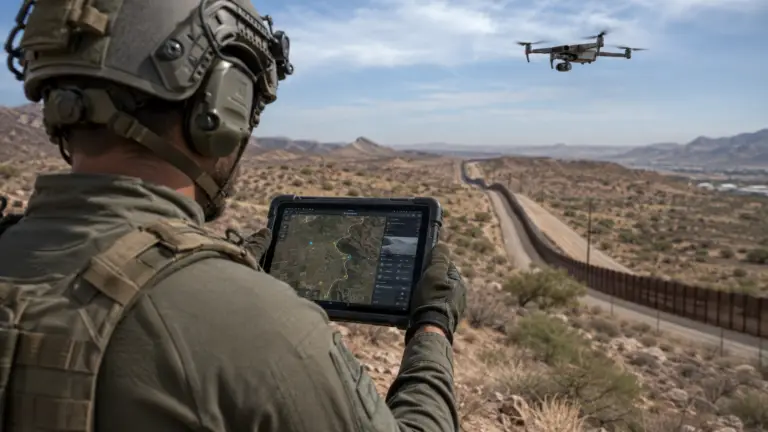
Electronic Warfare and Signal Protection: How Forces Secure Their Communications
The electromagnetic spectrum is a battlefield. Electronic warfare (EW) — the use of electromagnetic energy to attack, deceive, or protect — shapes the outcome of modern military operations as decisively as any weapon system. Forces that cannot protect their communications are operationally blind: their orders don’t reach subordinate units, their UAVs lose control links, their sensors go deaf. This guide examines the electronic warfare threat landscape, the technologies used to counter it, and what defense procurement professionals need to understand when building a communications-hardened force.
Understanding the Electronic Warfare Threat
Electronic warfare threats against military forces fall into three broad categories:
Electronic Attack (EA)
The offensive use of electromagnetic energy to degrade or deny the adversary’s use of the spectrum. This includes:
- Jamming — flooding a frequency band with noise to prevent communications or GPS reception
- Spoofing — transmitting false signals that mimic legitimate ones, causing GPS receivers or drone command links to navigate toward incorrect positions
- Directed energy attacks — high-powered microwave or laser systems that damage electronic components
Electronic Support (ES) / SIGINT
The collection of electromagnetic emissions to derive intelligence. When your forces transmit — on any frequency, at any power level — those transmissions are potentially detectable, locatable, and exploitable by adversary signals intelligence (SIGINT) systems.
Electronic Protection (EP)
Defensive measures to ensure continued use of the electromagnetic spectrum despite adversary electronic attack. This is the domain most relevant to force communications security.
The GPS Vulnerability: A Critical Dependency
Modern military forces have developed a profound dependency on GPS — for navigation, targeting, drone operation, and time synchronization. This dependency is also a critical vulnerability. GPS signals are weak and easily jammed. Adversaries at all levels — state and non-state — now operate GPS jamming equipment that can degrade navigation across a wide area.
GPS-denied operations require:
- Inertial navigation systems (INS) — dead-reckoning navigation that maintains positional accuracy without external signals
- Anti-jam GPS antennas — controlled reception pattern antennas (CRPA) that null jamming signals from specific directions
- Multi-constellation receivers — systems that receive GPS, GLONASS, Galileo, and BeiDou simultaneously, making simultaneous jamming of all signals much harder
- Training for GPS-denied operations — map reading, terrain association, and manual navigation remain essential skills
Communications Security: The Encryption Imperative
Unencrypted voice and data communications on the battlefield are a gift to adversary intelligence collection. Any transmission that can be received can be decoded — if it is not properly encrypted. Modern military communications security standards require:
End-to-End Encryption
All voice, data, and video transmissions must be encrypted before leaving the device. End-to-end encryption ensures that even if a transmission is intercepted, the content is unreadable without the correct cryptographic key.
Frequency Hopping
Military radios equipped with frequency-hopping spread spectrum (FHSS) technology change transmission frequency hundreds of times per second according to a pre-shared pattern. An interceptor who does not know the hopping pattern hears only noise.
Low Probability of Intercept/Detection (LPI/LPD)
Advanced waveforms deliberately reduce the probability that a transmission can be detected at all — spreading the signal across a wide bandwidth at very low power levels. LPI/LPD radios are particularly important for special operations and reconnaissance units.
Emission Control (EMCON)
Operational discipline to limit unnecessary transmissions. Every radio emission is a potential locating beacon for adversary direction-finding systems. EMCON procedures establish when forces may transmit and at what power levels.
Drone Communications: A Specific EW Vulnerability
The proliferation of tactical drones has introduced a specific electronic warfare vulnerability: the command-and-control link. Commercial drones operating on unencrypted, standard frequencies can be jammed, spoofed, or hijacked by adversary EW systems. This has been demonstrated in multiple recent conflicts with significant operational consequences.
Military-grade drone communications security requires:
- Encrypted, frequency-hopping C2 links that cannot be jammed on a single frequency
- Autonomous return-to-home behavior when the C2 link is lost — preventing capture
- Anti-spoofing GPS receivers that detect and reject false position signals
- Mission-stored flight plans that allow mission completion without a real-time C2 link
ARMA GIDEON’s drone solutions are configured with military-grade communications security as a baseline requirement — not an optional upgrade.
Building an Electromagnetically Resilient Force
Signal protection is not a single technology — it is an architecture. Building a force that can operate effectively under adversary electronic attack requires decisions across equipment, doctrine, and training:
Equipment Layer
- Encrypted, frequency-hopping tactical radios for all echelons
- Anti-jam GPS receivers for navigation and targeting systems
- EW-hardened drone C2 systems
- Backup communications (HF radio, satellite, messenger) for GPS/EW-denied conditions
Doctrine Layer
- EMCON procedures for each operational phase
- Backup communication plans for when primary means are jammed
- EW threat briefings as part of pre-mission planning
Training Layer
- Deliberate training in GPS-denied and communications-degraded environments
- Radio operator training on anti-jam and LPI/LPD modes
- EW awareness training for all personnel
The 2026 EW Landscape: What Has Changed
Electronic warfare has democratized rapidly. Capabilities that were once the exclusive domain of major military powers are now accessible to well-funded non-state actors. Commercial software-defined radio (SDR) platforms, widely available jamming hardware, and open-source signal intelligence tools have created an EW-capable adversary at every threat level.
Forces that were designed for a threat environment where only peer adversaries had EW capability are now operating in a world where any sophisticated group can jam GPS, intercept unencrypted communications, and attempt to hijack drone C2 links.
This shift demands that electronic protection measures be standard — not reserved for special operations or high-threat environments.
Protecting the Information Advantage
A force that communicates securely, navigates accurately in GPS-denied conditions, and maintains drone C2 links under jamming has a decisive information advantage. That advantage translates directly into operational effectiveness: faster decisions, better coordination, and more lethal action.
Electronic warfare protection is not a niche technical issue — it is a core operational requirement for any force expected to perform in a contested electromagnetic environment.
Consult with Our EW Specialists
ARMA GIDEON provides electronic warfare protection consulting and equipment supply for qualified military and security force clients. Our team assists with communications architecture review, equipment specification, and training program design.
Contact ARMA GIDEON to discuss your organization’s electronic warfare protection requirements.