Border threats have grown more complex, dynamic, and multi-domain. For defense procurement managers evaluating airborne ISR solutions, the VTOL tactical drone border surveillance category has become one of the most important capability classes available today. Hybrid VTOL platforms — combining vertical takeoff and landing with fixed-wing cruise efficiency — are now the preferred solution for persistent, no-runway border monitoring. This applies across land, coastal, and contested operational environments. This guide provides a structured framework for evaluating, specifying, and procuring military-grade VTOL systems capable of meeting modern border security requirements.
Why Border Surveillance Demands VTOL Over Conventional Drone Platforms
Traditional fixed-wing drones require prepared runways or catapult launch equipment. Multirotor systems offer operational flexibility but suffer from short endurance and limited range — typically under 60 minutes of useful flight time. Neither class fully satisfies the demands of sustained, wide-area border monitoring.
Hybrid VTOL platforms resolve this conflict. They launch and recover vertically from confined spaces — rooftops, vehicle platforms, small vessels, or forward operating bases — then transition to fixed-wing cruise mode for fuel-efficient, long-endurance flight. The result is a platform that combines the deployment flexibility of a multirotor with the range and endurance of a fixed-wing aircraft.
Key operational advantages include:
- No runway, catapult, or recovery net required
- Vertical deployment from vehicle rooftops or ship decks
- Transition to fixed-wing cruise for missions spanning 10–13+ hours
- Rapid setup by a two-person crew in under 20 minutes
- Low acoustic and thermal signature for covert border monitoring
For border security commanders, this means persistent aerial coverage without the logistics footprint of conventional aviation assets.
Core Tactical Capabilities of Military-Grade VTOL Drones
A VTOL tactical drone intended for border surveillance must carry more than a camera. Procurement specifications should address the full sensor and communications suite required for operational ISR.
Payload Integration
The standard mission payload for border surveillance combines:
- EO/IR cameras — electro-optical and infrared sensors for day/night detection and identification of personnel, vehicles, and watercraft
- SAR (Synthetic Aperture Radar) — all-weather, foliage-penetrating radar imaging for environments where optical sensors are degraded
- SIGINT modules — signals intelligence collection for electronic order of battle and communications monitoring in contested zones
- Laser range finders and target designators — for precision geolocation and handoff to ground response units
Endurance and Range
For persistent border patrol, the benchmark for Group 2 and Group 3 VTOL systems is 10 to 13+ hours of continuous flight. Combined with operational ranges exceeding several hundred kilometers, a single platform can monitor extended border segments with minimal crew rotation.
Breaking Defense’s analysis of Group 2 VTOL requirements for special forces ISR confirms that modern Group 2 platforms now execute missions previously reserved for much larger and more expensive assets.
Low-Profile and EW-Hardened Operation
Contested border environments — including GPS-denied zones, electronic jamming corridors, and heavily monitored airspace — demand platforms with hardened navigation and datalink resilience. Military-grade VTOL drones intended for these environments must incorporate:
- Anti-jamming GNSS with inertial navigation backup
- Encrypted, frequency-hopping datalinks
- Autonomous return-to-home in communication-denied conditions
- Low-observable profiles: reduced radar cross-section and acoustic dampening
Key Operational Scenarios for VTOL Border Surveillance
Land Border Monitoring
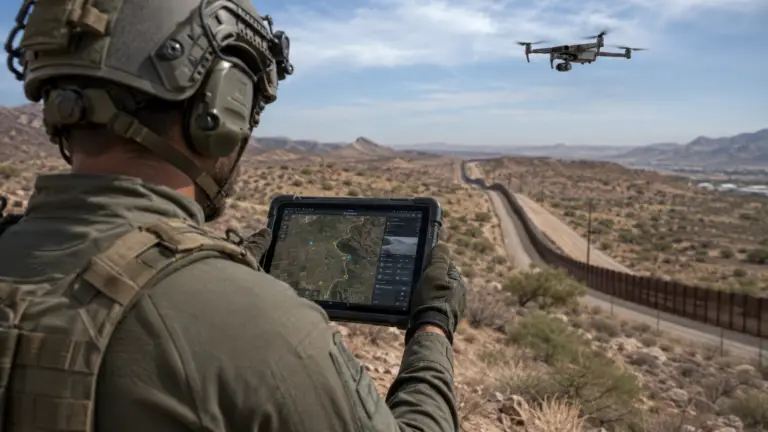
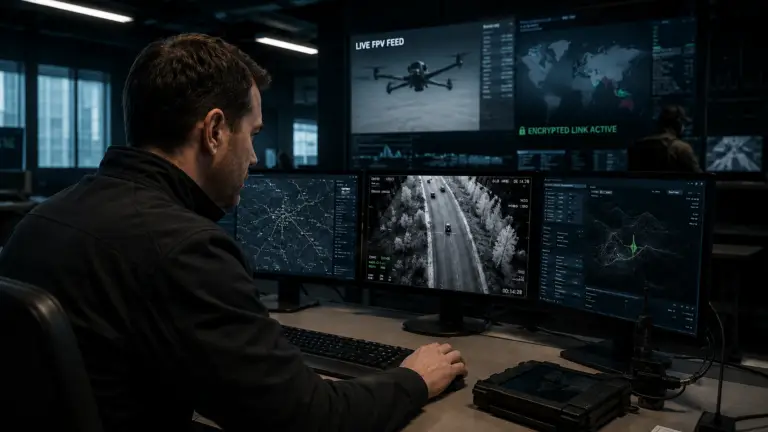
VTOL drones provide persistent overwatch along linear border segments, detecting infiltration attempts, vehicle movements, and perimeter breaches. Real-time EO/IR feeds are streamed to command posts, enabling rapid response force tasking before ground contact occurs.
Maritime Border Security
Coastal and sea-border surveillance is one of the most technically demanding border mission types. VTOL platforms operating from patrol vessels or coastal FOBs provide sea-lane monitoring, detection of unmanned surface vessels, and early warning of maritime infiltration. For a closer look at ARMA GIDEON’s capabilities in this domain, see our maritime border surveillance drone solutions.
Urban and Semi-Urban Border Zones
Dense terrain and proximity to civilian populations limit the use of large UAV platforms. Compact VTOL systems operating below 1,200 feet AGL can conduct close-quarter surveillance missions in built-up border zones without creating significant noise, visual, or legal exposure.
GPS-Denied and EW-Contested Environments
Modern adversaries employ GPS jamming and spoofing across contested border zones. Procurement specifications must require demonstrated performance in GPS-degraded conditions. Inertial navigation and visual odometry serve as the primary fallback guidance modes in these scenarios.
VTOL Drone Classification: Understanding Group 2 and Group 3 UAS for Border Missions
The U.S. Department of Defense and NATO member nations classify unmanned aerial systems into five groups based on weight, altitude, and airspeed. For tactical border surveillance, Group 2 and Group 3 are the operationally relevant classes.
| Group | Max Gross Weight | Operating Altitude | Notes |
|---|---|---|---|
| Group 2 | 21–55 lbs | Below 3,500 ft AGL | Tactical ISR, border patrol, forward reconnaissance |
| Group 3 | Under 1,320 lbs | Below 18,000 ft MSL | Medium-endurance persistent ISR, heavier payloads |
Group 2 platforms are the preferred procurement target for most border surveillance applications. They are deployable by small teams, transportable in standard tactical vehicles, and capable of sustained ISR without the logistical demands of larger systems.
Ukraine’s operational experience has validated this class as the dominant procurement priority for contested ISR environments, accelerating demand across NATO procurement frameworks.
Procurement Standards and Compliance Criteria
Defense procurement managers should specify the following standards as minimum threshold requirements for VTOL tactical drone border surveillance platforms.
MIL-STD-810
Environmental ruggedization covering temperature extremes, humidity, dust ingress, vibration, and shock. Essential for platforms deployed in desert, arctic, coastal, and high-altitude border zones.
MIL-STD-461
Electromagnetic compatibility — the platform and its ground control station must not interfere with co-located communications and electronic warfare systems.
STANAG 4586
STANAG 4586 — NATO’s interoperability standard for UAS command and control defines the data link interface, ground control station interface, and human-machine interface requirements for NATO-interoperable UAS. Procurement managers sourcing for NATO-aligned forces should treat STANAG 4586 compliance as a non-negotiable requirement.
Export Control Compliance
VTOL drone platforms incorporating controlled technology are subject to ITAR (International Traffic in Arms Regulations) and EAR (Export Administration Regulations) licensing requirements in the United States. Israeli defense exports are governed under the Israeli Defense Export Controls Law. Procurement managers should confirm that the supplier holds all required export authorizations before advancing to contract negotiation.
Integrating VTOL Drones with Counter-UAV and Border Defense Systems
VTOL ISR platforms do not operate in isolation. In a layered border defense architecture, they function as the persistent sensing layer that cues and supports ground-based response systems — including counter-UAV detection and interdiction systems.
The operational integration model follows a five-step chain:
- Detect: VTOL drone EO/IR and radar payloads identify threat signatures at extended range
- Classify: Onboard AI processing or operator analysis determines threat type and intent
- Track: Continuous overwatch maintains positional data on the threat
- Cue: Target data is passed to counter-UAV systems, ground response forces, or maritime intercept assets
- Respond: Interdiction is executed while the VTOL platform maintains persistent coverage
This architecture is particularly relevant for border environments where hostile drone incursions are a primary threat vector. A VTOL surveillance drone that can detect, track, and cue a counter-UAV response chain provides layered defense value well beyond simple aerial observation.
Drone-versus-drone threat scenarios require that ISR platforms and counter-UAS systems share a common command-and-control architecture and data fusion backbone. Procurement managers should verify that candidate platforms support open data standards and are tested in integrated C-UAS exercises before contract award.
Evaluating VTOL Tactical Drone Suppliers: A Checklist for Procurement Managers
Procurement managers should assess potential suppliers against the following criteria before advancing to technical evaluation or RFI submission.
Operational Track Record
Has the platform been deployed in live border surveillance operations? Demonstrated performance in contested, real-world environments — not only controlled test conditions — is the most reliable indicator of operational reliability. Suppliers with active-environment operational experience bring mission-tested knowledge that laboratory testing programs cannot fully replicate.
Payload Modularity
Can the platform be reconfigured for different mission profiles? A modular payload architecture allows border security operators to switch between EO/IR, SAR, SIGINT, and communications relay roles without procuring separate platforms.
Training Ecosystem
How does the supplier support operator certification? VR-based simulation training for drone operators compresses training timelines, reduces airframe hours on operational platforms, and enables rehearsal of contested and emergency scenarios that cannot be safely replicated in live flight. Evaluate whether the supplier offers a validated simulation-based training pathway.
Sustainment and Field Support
Procurement cost is only one component of total cost of ownership. Spare parts availability, in-country maintenance support, and field-deployable repair capability determine whether a platform remains operational across its full service life. Suppliers should provide clear sustainment commitments at the RFI stage.
Cyber Resilience
The datalink, ground control station, and mission data pipeline of any VTOL platform represent potential attack surfaces. Procurement managers should require documented cyber resilience assessments, encrypted communications, and hardened software stacks as standard specifications.
ARMA GIDEON’s VTOL Drone Capabilities for Border Surveillance
ARMA GIDEON is an official Israeli defense supplier with operational experience in tactical drone systems, counter-UAV solutions, maritime security, and defense simulation. Our VTOL drone capabilities are developed and evaluated against the requirements of real border security environments — not theoretical specifications alone.
The ARMA GIDEON border surveillance portfolio addresses the full operational requirement:
- Hybrid VTOL platforms — no-runway deployment, 10+ hour endurance, EO/IR and multi-sensor payload integration
- Counter-UAV integration — VTOL ISR platforms designed to operate within layered C-UAS architectures
- Maritime capability — platforms configured for vessel-based launch and sea-border monitoring
- Operator training — VR simulation training programs for VTOL drone operators, reducing live airframe training hours
- Compliance and export readiness — platforms supplied with full documentation for NATO-aligned procurement processes
The global VTOL UAV market is valued at approximately USD 5.1 billion in 2025 and is projected to reach USD 15.0 billion by 2034, with defense border surveillance representing one of the fastest-growing procurement segments. Defense procurement managers can find increasing coverage of VTOL ISR procurement priorities in Jane’s Defence & Security Intelligence and across NATO procurement frameworks.
Request a Capability Briefing from ARMA GIDEON
Defense procurement timelines are demanding. The earlier a qualified supplier is engaged in the requirements definition process, the better aligned the delivered capability will be to operational needs.
ARMA GIDEON works directly with defense procurement managers, border security commands, and system integrators to define requirements, provide capability demonstrations, and support the full procurement cycle — from RFI response through to deployment and operator training.
To request a capability briefing, technical datasheet, or supplier qualification package, contact ARMA GIDEON directly:
Email: office@arma-gideon.com
Website: www.arma-gideon.com
Our team will respond within one business day to schedule a briefing aligned to your procurement timeline and classification requirements.
ARMA GIDEON — Official Israeli Defense Supplier | VTOL Drones | Counter-UAV | Maritime Security | Defense Simulation