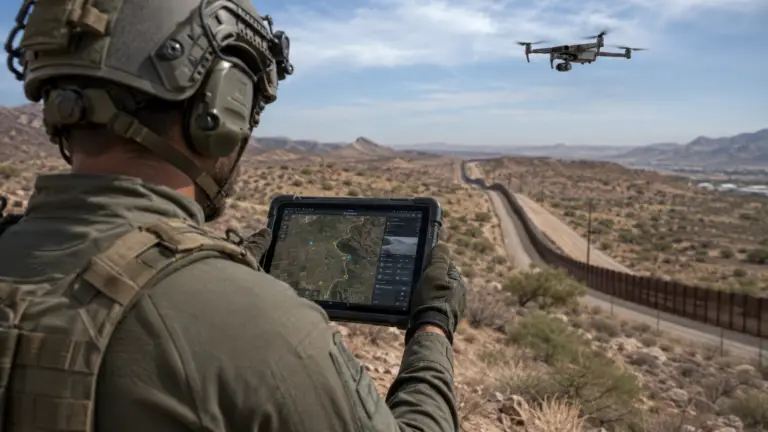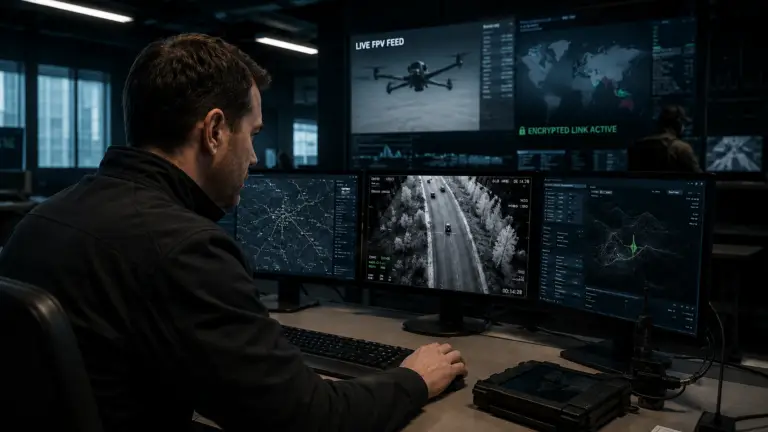
Tactical drones are transforming CQB operations in ways that were unthinkable a decade ago. Close quarters battle — the most lethal and high-stakes environment any operator will face — has historically relied on speed, surprise, and human courage to overcome the inherent risk of breaching unknown spaces. Today, unmanned micro-systems are changing that calculus entirely. Special forces commanders and procurement officers worldwide are accelerating the integration of small UAVs into their tactical doctrine, and for good reason: drones deliver actionable intelligence before a single operator crosses the threshold.
This article examines how tactical drones are reshaping CQB doctrine, what capabilities procurement officers should evaluate, and how ARMA GIDEON supports defense organizations making this critical transition.
The New Reality of Close Quarters Battle
Why CQB Remains the Most Dangerous Mission
Urban combat and close quarters battle consistently produce the highest casualty rates of any operational environment. Confined spaces eliminate stand-off advantages. Fragmentation risks multiply. Every doorway, stairwell, and room corner conceals a potential threat. The asymmetry is stark: a defender with partial concealment holds a decisive advantage over an attacker moving through a fatal funnel.
Despite advances in body armor, night vision, and weapons technology, the fundamental problem of CQB has remained constant for decades. Operators do not know what is on the other side of the door. They do not know the room layout, the number of threats, the position of non-combatants, or whether an improvised explosive device waits at the entry point. This uncertainty costs lives.
The Intelligence Gap That Gets Operators Killed
Military after-action reviews consistently identify the same root cause behind CQB casualties: insufficient pre-entry intelligence. Traditional methods — static surveillance, thermal imaging from external positions, or informant reports — provide incomplete pictures that degrade rapidly in dynamic situations. By the time a team breaches, the intelligence is already minutes old. In CQB, minutes are an eternity.
The result is what tactical trainers call “blind entries” — the single most dangerous act in special operations. Every blind entry is a decision made on incomplete information in an environment specifically designed to favor the defender.
How Tactical Drones Change the CQB Equation

Pre-Entry Intelligence and Angle Management
The concept of D-CQB — Drones in Close Quarters Battle — addresses the intelligence gap directly. A compact micro-UAV can be deployed from outside a structure, fly through an open window or ventilation point, and transmit live video to the entire tactical element within seconds. What once required a full reconnaissance package now happens in under a minute.
Pre-entry intelligence from a tactical drone delivers three critical capabilities:
- Room mapping: The drone identifies the physical layout — furniture, obstacles, and potential cover positions — before the team enters.
- Threat location: Live thermal or electro-optical imagery reveals the position of personnel inside, distinguishing armed combatants from civilians.
- Hazard detection: IEDs, booby traps, and fortified positions can be identified before any operator is exposed.
Angle management is the second major contribution of CQB drones. Every room contains dead space — areas invisible from the breach point that a defender can exploit. Traditional breach doctrine requires operators to physically clear these angles under fire, accepting significant risk. A drone sweeps those angles remotely, eliminating the guesswork and the exposure.
Real-Time Situational Awareness for the Entire Stack
One of the most underappreciated advantages of drone integration in CQB is the democratization of situational awareness. Historically, the lead operator had the most current intelligence, and information degraded as it passed back through the team. By the time the last element in the stack received a verbal update, the situation had changed.
With a drone operator embedded in the team and a live feed distributed to each member’s display, every operator in the stack shares the same operational picture simultaneously. Coordination improves. Reaction times compress. Communication errors — a leading cause of fratricide — decrease significantly.
The U.S. Army’s testing of short-range reconnaissance UAS with the 101st Airborne Division and 10th Mountain Division has demonstrated measurable improvements in tempo and decision quality when drones are fully integrated into unit operations, not used as supplemental assets. As Breaking Defense reported from AUSA 2025, the defense industry is accelerating investment in small unmanned systems because battlefield commanders are demanding these capabilities at the squad and team level.
Key Capabilities for CQB Drone Operations
GPS-Denied Navigation
Most tactical environments where CQB is conducted — urban interiors, subterranean facilities, hardened structures — deny GPS signals. A drone that relies on satellite navigation becomes unreliable or inoperable in precisely the conditions where it is needed most.
Purpose-built CQB drones use 3D computer vision-based positioning and onboard sensor fusion to maintain stable flight and precise hovering without GPS. This capability is not optional for serious operational use — it is a baseline requirement. Any platform evaluated for CQB integration must demonstrate reliable autonomous stabilization in GPS-denied conditions.
Low Acoustic and Visual Signature
A drone that announces its approach compromises the entire operation. In CQB, the tactical advantage of drone reconnaissance is only realized if the platform reaches its observation position without alerting threat personnel.
CQB-configured micro-drones are engineered for minimal acoustic and visual signature. Brushless motor configurations reduce operational sound. Dark or low-reflectivity surfaces minimize visual detection in both daylight and night-vision conditions. Nano-class systems weighing under 40 grams demonstrate what is achievable when signature reduction is a primary design requirement.
Rapid Deployment and Recovery
Mission tempo in CQB is measured in seconds. A drone system that requires setup time, calibration, or multiple operators to deploy creates a tactical liability rather than an advantage. The standard for CQB drone deployment should be toss-to-fly capability: a single operator removes the platform from a carry pouch and has it airborne in under 30 seconds.
Recovery must be equally rapid. After providing pre-entry intelligence or conducting live surveillance during a clearance, the drone must be retrievable or expendable. For some missions, loss of the platform is an acceptable cost. For others, full recovery within a short time window is required. Procurement officers must specify this requirement clearly.

Integrating Drones into CQB Team Structure
The Embedded Operator Model
The most effective CQB drone employment is not a centralized capability operated by a separate ISR element — it is an embedded asset operated by a member of the tactical team itself. Research and operational experience consistently support this model over external specialist teams.
The embedded operator understands the team’s immediate tactical intent. They know when the team is preparing to breach, when the angle of a specific room requires priority surveillance, and when the drone must be recovered to avoid compromising the next phase. External operators, regardless of skill, cannot replicate this context.
The practical implication for force structure is significant. Units adopting CQB drones must train all operators — not just designated drone specialists — to a basic proficiency level. The embedded model requires cross-trained personnel who can maintain tactical roles while managing a drone asset when needed.
Training and SOP Development
Successful drone integration into CQB doctrine requires structured SOP development before any operational deployment. Ad hoc use of drone assets without established protocols creates confusion, degrades team coordination, and can expose the unit to additional risk.
Effective CQB drone SOPs address six key areas:
- Standardized callouts: Consistent verbal and hand-signal protocols for drone status, battery level, and intelligence reports.
- Air-ground coordination: Clear deconfliction procedures to prevent the drone from masking fields of fire or interfering with breaching actions.
- Battery and endurance management: Mission planning that accounts for drone flight time and identifies recharge or swap points.
- Handoff procedures: Defined processes for transferring drone control between operators during extended clearances.
- Recording and documentation: Protocols for capturing drone footage for after-action review and intelligence exploitation.
- Failure procedures: Actions on drone malfunction, signal loss, or uncontrolled landing within the operational area.
ARMA GIDEON’s CQB training programs incorporate drone integration modules alongside traditional close quarters battle instruction, ensuring teams develop both the tactical skills and the procedural framework to operate effectively.
Procurement Considerations for Defense Buyers
Mission-Critical Specifications
Defense procurement officers evaluating tactical drones for CQB integration must prioritize operational requirements over commercial specifications. Consumer-grade performance figures are not meaningful references for military procurement. The specifications that matter in CQB are:
| Parameter | CQB Minimum Requirement |
|---|---|
| GPS independence | Full indoor operation without GPS |
| Flight time | 8–15 minutes per charge |
| Deployment time | Under 30 seconds from storage to flight |
| Video latency | Under 100ms for operational use |
| Acoustic signature at 5m | Below conversational noise level |
| Operating range | 50–200m depending on structure |
| Weight | Under 500g for toss-launch capability |
| Impact resistance | Survives controlled crash into hard surface |
Evaluating CQB Drone Platforms
The tactical drone market has expanded rapidly, creating a wide range of platforms with varying suitability for CQB operations. Procurement officers should structure evaluations around operational scenarios rather than technical specifications alone.
Live force-on-force exercises with drone integration provide more actionable procurement data than laboratory testing. A platform that performs well in controlled conditions but disrupts team coordination in realistic training scenarios is not a suitable CQB asset. Conversely, a technically modest platform that integrates smoothly into established unit procedures may deliver superior operational value.

ARMA GIDEON supports defense organizations through the full procurement lifecycle — from capability assessment and vendor evaluation to integration support and operator training. Our tactical drone solutions span multiple mission profiles, and our advisory teams have direct experience selecting and fielding platforms for demanding operational environments.
The Counter-Drone Dimension of CQB
No discussion of tactical drones in CQB is complete without addressing the adversarial dimension. As friendly forces integrate drones into CQB doctrine, opposing forces will develop countermeasures — and will deploy their own drone assets in the same environments.
The implications are significant. Special forces commanders must now plan for the possibility that a threat actor has already deployed micro-drones for surveillance before the breach, or will deploy armed FPV drones in response to entry. Units entering a building should assume the possibility of drone-borne threats and incorporate counter-drone procedures into their CQB SOPs.
ARMA GIDEON’s counter-UAV solutions provide detection and neutralization capabilities scaled for tactical unit use, including systems compatible with CQB team loadout requirements. Integrating both offensive drone capabilities and counter-drone awareness creates a comprehensive approach to the unmanned dimension of urban combat.
The Strategic Imperative
The integration of tactical drones into CQB operations is no longer an experimental capability reserved for tier-one special operations units. It is becoming a baseline requirement for any force expected to conduct urban operations against determined adversaries.
The U.S. Army’s public commitment to purchasing thousands of small drones for tactical units, SOCOM’s pursuit of multi-domain micro-systems, and the international community’s accelerating adoption of drone-enabled assault doctrine all point to the same conclusion: units that have not integrated drones into their CQB training and operational procedures are falling behind.
As noted in the Small Wars Journal’s analysis on unmanned systems transformation, the organizational transformation required to maximize unmanned systems integration goes beyond equipment procurement. Doctrine, training pipelines, and command structures must all adapt to a reality in which drones are present in virtually every tactical environment.
How ARMA GIDEON Supports Your CQB Drone Integration
ARMA GIDEON is an official Israeli defense supplier with direct experience in tactical drone systems, CQB training, and counter-UAV capabilities. We work with special forces units, national guard formations, and defense procurement agencies to evaluate, acquire, and integrate drone assets for demanding operational requirements.
Our approach combines equipment advisory services with operational training — because the most capable drone system delivers limited value without the procedures and skills to employ it effectively. We understand that procurement decisions in this space carry operational consequences, and we support our clients through every phase of the integration process.
Consult ARMA GIDEON’s Tactical Drone Specialists
The transition to drone-enabled CQB is already underway across elite military organizations worldwide. Your unit’s readiness depends on making the right procurement and training decisions now.
Contact ARMA GIDEON today to discuss your tactical drone requirements, request a capability briefing, or arrange an operational assessment. Our specialists are available to support defense procurement officers and special forces commanders at every stage of the integration process.
Reach us at: office@arma-gideon.com or visit www.arma-gideon.com to learn more about our full range of tactical solutions.