The global maritime domain faces an unprecedented convergence of threats in 2026. Maritime security solutions have never been more critical — piracy, smuggling networks, drone attacks on vessels, and surging cyber incidents are reshaping how naval commanders, coast guard agencies, and port security managers defend their assets. With the maritime security market projected to grow from USD 33 billion in 2025 to USD 58 billion by 2032, investment in integrated protection is accelerating worldwide. This article examines the key threats of 2026 and outlines the technologies and strategies needed to secure ports, coastal zones, and vessels against them.
The Evolving Maritime Threat Landscape in 2026
The threat environment confronting naval forces and port operators in 2026 is multi-dimensional. Traditional dangers have evolved, and entirely new categories of attack have emerged. Understanding each threat vector is the first step toward building an effective defense.
Piracy and Armed Robbery at Sea
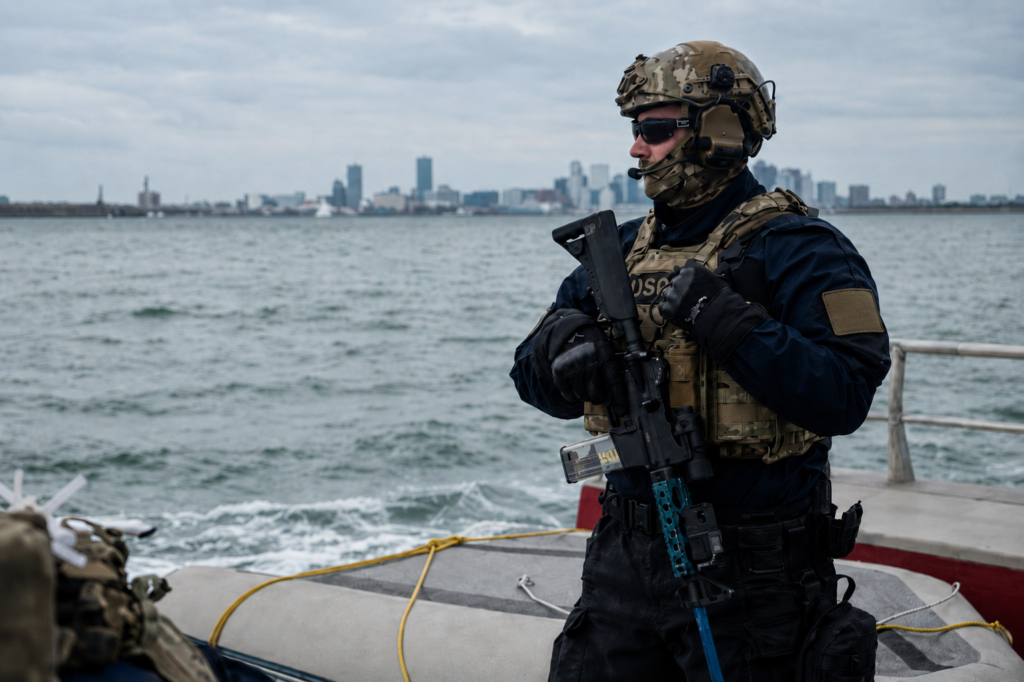
Somali piracy has resurged in 2026, with active vessel hijackings reported in the Indian Ocean. The Gulf of Guinea remains a high-risk zone for armed robbery. In the Red Sea and Gulf of Aden, Houthi attacks on commercial shipping have disrupted major trade lanes, prompting direct UN Security Council attention. Naval commanders operating in these regions require persistent surveillance, rapid reaction capability, and vessel hardening measures to mitigate exposure.
Smuggling, Trafficking, and Illegal Fishing
Illicit maritime trade — narcotics, weapons, and human trafficking — continues to exploit vast, under-monitored stretches of coastal and open water. Illegal, unreported, and unregulated (IUU) fishing further strains maritime law enforcement resources. Effective interdiction requires layered detection systems that can distinguish threat vessels from legitimate maritime traffic across wide ocean areas.
Drone and UAV Attacks on Vessels and Ports
Unmanned aerial and maritime vehicle attacks have emerged as a defining threat of this era. In 2026, a single UAV strike on a Black Sea port involved more than 112 drones intercepted by defense systems. Drone swarms have been deployed targeting oil infrastructure at sea. This threat is no longer theoretical — it is operational. Ports and naval installations without counter-drone capability are exposed to a threat for which traditional air defense is not optimized.
Cyber Threats to Maritime Infrastructure
Maritime cyber incidents surged by 103% in 2025 compared to the previous year, according to industry monitoring data. Ransomware, DDoS attacks, and malware infections are the leading attack vectors. Ship navigation systems, port operational technology (OT), and vessel communication networks are all viable targets. As vessels become more digitally integrated, the attack surface grows. The International Maritime Organization (IMO) has incorporated cyber risk management requirements into its regulatory framework, reinforcing that cyber defense is now a core maritime security obligation. See the IMO Maritime Security guidelines for the current international framework.
Core Maritime Security Solutions for Modern Naval Forces
Effective maritime security in 2026 is not achieved through any single platform or system. It requires a layered architecture that integrates sensors, command and control, physical interdiction, and cyber defense. The following solution categories form the foundation of a modern maritime security posture.
- Surveillance and Monitoring: Persistent maritime domain awareness (MDA) using radar, AIS tracking, electro-optical/infrared (EO/IR) sensors, and satellite feeds. Integrated command centers fuse data from multiple sources to provide a real-time common operating picture.
- UAV and Drone Patrol: Unmanned aerial vehicles extend surveillance reach far beyond what surface assets can cover. Autonomous drone systems conduct continuous perimeter monitoring, detect unauthorized vessels, and provide ISR support to coast guard and naval units.
- Counter-UAV (C-UAS) Systems: Dedicated systems to detect, classify, track, and neutralize rogue drones threatening vessels, ports, and offshore platforms.
- Cyber Defense: Hardening of vessel navigation and communication systems, port OT networks, and shore-side command infrastructure against intrusion, manipulation, and denial-of-service attacks.
- Access Control and Physical Security: Biometric access, CCTV, underwater sonar detection for diver threats, and automated barrier systems at port perimeters.
Port Security: Layered Defense from Perimeter to Pier
Ports are among the most complex security environments in the world. They combine industrial infrastructure, civilian personnel, commercial cargo, and government operations into a single, high-value target. A layered defense model is essential.
The outer perimeter begins at sea. Radar and passive acoustic sensors establish a surveillance zone around the port approach. Vessels are tracked and identified before they enter restricted waters. Anomalous behavior triggers alerts to a centralized command post.
At the waterline, underwater sonar systems detect diver or submersible threats. Above the waterline, fixed and pan-tilt-zoom (PTZ) cameras with AI-driven analytics monitor piers, cargo areas, and vessel berths. Thermal imaging maintains coverage at night and in low-visibility conditions.
Inside the port, access control systems restrict movement to authorized personnel and vehicles. Cargo screening technologies — X-ray, radiation detection, chemical sensors — address the smuggling threat at the point of entry.
All of these layers are coordinated through a unified Port Security Management System (PSMS). This allows security managers to respond rapidly to incidents across the entire facility.
Coastal Surveillance and Maritime Domain Awareness
Protecting coastlines requires surveillance infrastructure that can cover vast distances with limited personnel. Modern maritime domain awareness (MDA) systems combine several technologies into a coherent network.
| Technology | Function | Coverage Advantage |
|---|---|---|
| Coastal Radar (HFSWR / X-band) | Continuous vessel detection and tracking | Covers coastal approach zones 24/7 |
| AIS Integration | Vessel identity, course, and speed data | Flags vessels without transponders |
| SAR Satellite Imagery | Wide-area maritime coverage | Detects vessels beyond land-based radar range |
| AI-Driven Analytics | Anomaly detection and threat prioritization | Reduces false alarms; extends small team coverage |
Recent deployments of 50+ coastal surveillance radars in a single national program illustrate the scale of investment currently underway in maritime infrastructure worldwide.
Drone and UAV Integration in Maritime Security Operations
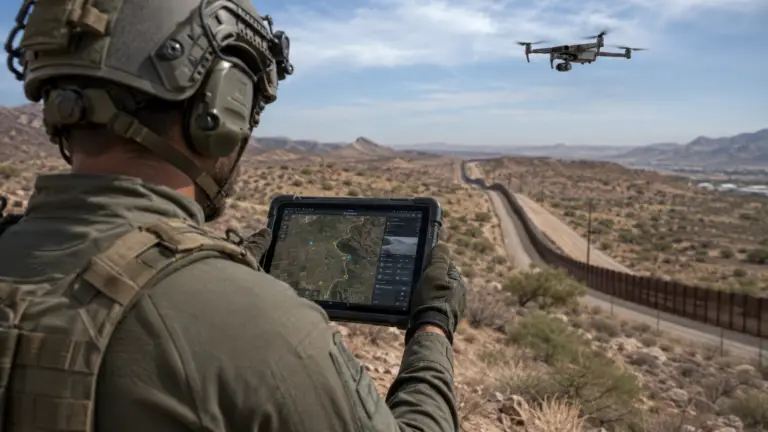
The use of unmanned aerial systems in maritime security has accelerated rapidly. For port authorities and coastal commands, drone patrol programs offer significant operational advantages. A single UAV can monitor a harbor perimeter that would require dozens of physical guard posts. Drone-in-a-box systems enable automated, schedule-based patrols without requiring a trained pilot on standby. When an alert is triggered, a drone can be on-station within minutes.
ARMA GIDEON’s VTOL surveillance drone platforms are designed for maritime patrol missions. They combine long endurance, vertical take-off and landing capability for ship or pier-based operations, and multi-sensor payloads including EO/IR cameras and radar.
For close-area operations in congested port environments, tactical drone platforms provide agile reconnaissance and rapid response capability that fixed surveillance systems cannot match.
Counter-UAV Systems for Ports and Coastal Zones
The drone threat to maritime infrastructure demands dedicated counter-UAV (C-UAS) capability. A passive surveillance network cannot stop an incoming drone — it can only alert defenders. Effective port protection requires an integrated C-UAS system that covers detection, identification, and neutralization.
Detection layers typically combine RF spectrum monitoring, radar, acoustic sensors, and electro-optical cameras. Each sensor has different strengths and limitations. A multi-layered approach ensures detection even when adversaries attempt to defeat individual sensor types.
Neutralization methods range from RF jamming and GNSS spoofing — which bring drones down without physical destruction — to directed energy systems and interceptor projectiles for high-threat scenarios. The choice of neutralization method depends on the operational environment, rules of engagement, and proximity to civilian areas.
ARMA GIDEON’s counter-UAV systems are deployed in port and coastal environments. They provide commanders with a complete detect-to-defeat capability against the full range of current and emerging drone threats.
Cyber Defense for Vessels and Port Systems
The 103% surge in maritime cyber incidents in 2025 makes cyber defense a front-line maritime security priority. For naval commanders and port managers, the key areas of vulnerability are:
- Navigation systems (GPS, AIS, ECDIS)
- Operational technology controlling port cranes, access systems, and fuel infrastructure
- Vessel communication and satellite link systems
Effective maritime cyber defense requires network segmentation — keeping OT and IT networks separate. It also requires continuous monitoring for anomalous traffic and incident response planning. Crew and staff training remains the most cost-effective mitigation for phishing and social engineering attacks.
International regulatory compliance is also a driver. The IMO’s guidelines on maritime cyber risk management require vessel operators to integrate cyber risk into their Safety Management Systems (SMS). Port state control inspections increasingly include cyber resilience assessments.
ARMA GIDEON Maritime Security Capabilities
ARMA GIDEON is an Israeli defense supplier with a proven track record in delivering integrated security solutions to naval forces, coast guard agencies, and port authorities. Our maritime security portfolio addresses the full threat spectrum facing commanders in 2026.
- Maritime Surveillance Drones: VTOL platforms optimized for long-endurance coastal and port patrol, with multi-sensor payloads and encrypted data links.
- Counter-UAV Systems: Integrated detect-to-defeat solutions for port perimeters, naval installations, and offshore platforms.
- Tactical UAV Platforms: Agile, rapidly deployable drones for close-area reconnaissance and port security response.
- Command and Control Integration: Systems designed to fuse data from multiple sensor types into a unified maritime common operating picture.
ARMA GIDEON’s solutions are designed for operational environments where reliability, rapid deployment, and interoperability with allied systems are non-negotiable requirements.
Conclusion: Building a Resilient Maritime Security Posture
The maritime threat environment of 2026 demands more than reactive security. Naval commanders, coast guard agencies, and port security managers need integrated, proactive systems. These systems must deliver persistent awareness, rapid response, and resilience against the full range of threats — from piracy and drone swarms to cyber intrusion.
The technologies and strategies outlined in this article form the building blocks of that posture. The critical factor is integration: surveillance, counter-drone, cyber defense, and physical security must work as a unified system, not as isolated capabilities.
Ready to strengthen your maritime security posture? Contact ARMA GIDEON today to discuss how our maritime surveillance drones, counter-UAV systems, and integrated defense solutions can be tailored to your operational requirements.